
Class Descriptions
We teach from a structured curriculum that our experienced staff updates every year. Learn about the skills your dancer will build and how they progress through our levels.
Not sure where your dancer fits? Take our short quiz and we'll point you to a good first class, or see class times.
Littles
The Littles program, ages 2 to 6
Hip-Hop Jr. (ages 5 to 6) is listed with Hip Hop.
Intro to Dance
Age 2 · 45 minute class · Usually 1 year at this level
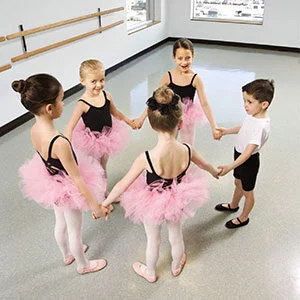
This is a beginning dance class for 2 year olds. It explores movement and dance in a fun, playful manner. The class is 45 minutes in length and incorporates basics of ballet, rhythm and tumble. Students need to wear a leotard, tights, and ballet shoes. This class takes part in our holiday tea parties and our end of year recital.
The year at a glance
Fall September to November
Warm-up
- Circle Dance and Claps
- Stretches
Center Barre
- Rainbow Right & Lovey Left
- Parallel Position
- Parallel Demi-plié
- Arm port de bras with parallel Demi-plié
- Arm port de bras with turn out Demi-plié
- Élevé
- Parallel Tendu devant
- Parallel Battement Piqué devant
- Parallel Passé
- Parallel Temps lié
- 1st Position
- Sauté Parallel
- Arabesque
- 2nd Position
- Baby 1st Demi-plié
Across the Floor
- Circus tightrope
- Kangaroo jumps
- Marching
- Bourrée
- Leaping through the pumpkin patch
- Butterfly/humming bird walks
- Passé walks
- Chassés (facing mirror)
Tumble
- Animals (butterflies, crab walks, frog jumps, mermaid walks, bear crawls)
- Donkey kicks
- Plank walk
- Log rolls
- Rocking chair
- Forward rolls (tuck chin)
Winter December to February
Center Barre
- Baby turn out Temps lié
- Échappé Sauté parallel
Across the Floor
- Chassés (facing side)
Spring March to May
Center Barre
- Sauté quarter turns parallel
After this level
Next: Creative Movement 1
Creative Movement 1 is built for three year olds turning four. Class runs 45 minutes and explores dance through imagery and props, with more ballet in it than Intro. There is a holiday tea party, and the year ends with a ballet dance in the recital.
What to wear
Tights, leotard, pink ballet shoes (skirts are fine). Boys: black ballet shoes. Creative Movement 2, Ballet/Tap Combo 1 and Ballet/Tap Combo 2 require black tap shoes.
Creative Movement 1
Age 3 · 45 minute class · Usually 1 year at this level
This is a dance class designed for the brain and muscle development of three year olds, turning four, throughout the school year. It is a guided class that explores dance through imagery and props. The class is 45 minutes in length and incorporates basics of ballet, rhythm and tumble. Students need leotard, tights, and ballet shoes. This class takes part in our holiday tea parties and performs a ballet dance during the end of year recital.
The year at a glance
Fall September to November
Warm-up
- Circle Dance and Claps
- Stretches
Center Barre
- Rainbow Right & Lovey Left
- Parallel Position
- Parallel Demi-plié
- Arm port de bras with parallel Demi-plié
- Arm port de bras with turn out Demi-plié
- Élevé
- Parallel Tendu devant
- Parallel Battement Piqué devant
- Parallel Passé
- Parallel Temps lié
- 1st Position
- Sauté Parallel
- Arabesque
- 2nd Position
- Baby 1st Demi-plié
Across the Floor
- Circus tightrope
- Kangaroo jumps
- Marching
- Bourrée
- Leaping through the pumpkin patch
- Butterfly/humming bird walks
- Passé walks
- Chassés (facing mirror)
Tumble
- Animals (butterflies, crab walks, frog jumps, mermaid walks, bear crawls)
- Donkey kicks
- Plank walk
- Log rolls
- Rocking chair
- Forward rolls (tuck chin)
Winter December to February
Center Barre
- Baby turn out Temps lié
- Échappé Sauté parallel
Across the Floor
- Chassés (facing side)
Spring March to May
Center Barre
- Sauté quarter turns parallel
After this level
Next: Creative Movement 2
The class stretches to a full hour and tap joins the ballet. This is the year for four year olds turning five, still taught through imagery and play. At the recital they perform a tap dance and a ballet dance.
What to wear
Tights, leotard, pink ballet shoes (skirts are fine). Boys: black ballet shoes. Creative Movement 2, Ballet/Tap Combo 1 and Ballet/Tap Combo 2 require black tap shoes.
Creative Movement 2
Age 4 · 60 minute class · Usually 1 year at this level
This is a dance class designed for the brain and muscle development of four year olds, turning five, throughout the school year. It is a guided class that explores dance through imagery and props. The class is 1 hour in length and incorporates basics of ballet, tap and tumble. Students need leotard, tights, tap and ballet shoes. This class takes part in our holiday tea parties and performs a tap and ballet dance during the end of year recital.
The year at a glance
Fall September to November
Share Time
- Circle Dance and Claps
- Stretches
Warm-up
- Rhythm work with a drum and clapping, walking around the room to counts of 4 and 8
- Garden Warm-up
Center Barre
- Rainbow Right and Loving Left
- Parallel Position
- 1st Position
- Parallel Demi-plié
- Arm port de bras with Demi-plié
- Parallel Tendu
- Parallel Battement Piqué
- Parallel Flamingo Passé
- 2nd Position
- 1st Position Demi-plié
Center Work
- Parallel temps lié
- Sauté Parallel 1st position
Across the Floor
- Marches (finding the beat)
- Stamp like a dragon; Stomp out the fire
- Alligator (heel toe walks)
- Penguin Walks
- Toe heel walks
- Combo march and jump
- Step together step clap
- Grapevine
- Crawls
- 3 point crawls (lemon drops)
- Shuffles alternating
- Circus tightrope
- Chassés (facing mirror)
- Kangaroo jumps
- Marching
- Cross body Movements
- Flaps
Tumble
- Animals (butterflies, crab walks, frog jumps, mermaid walks, bear crawls)
- Log rolls
- Plank
- Rocking chair
- Forward rolls (tuck chin)
Skills
- Hop, leap, jump
- Step (no heels)
- Touch (no weight)
- Heel dig (no weight)
- Toe Knocks and Ball drops
- Step together step clap
- Shuffle (brush/spank)
- Paradiddles
- Cramp roll
- Swinging doors
- Dig step heel
- Cowgirl swings
- Shuffles alternating
- Ball change
- Grapevine
- Crawls
Improv
- Guess What I’m Saying
- Circle Tap Tag
- Call and Echo
- Drum
- Stick
- Clapping song
Winter December to February
Center Barre
- 1st Position Tendu
- Cou-de-pied to passé
- Parallel Dégagé
Center Work
- Arabesque
- Baby turn out Temps lié
- Sauté turn out, 1st position
- Échappé parallel/baby turn out
- Sauté quarter turns parallel/baby turn out
Across the Floor
- Skipping
- Tippy toe walks
- Flamingo Passé
- Leaps over a prop
- Chassés (facing side)
- Run like a Dancer
Tumble
- Straddle rolls
- Backward rolls
- Bridges
Skills
- 3 point riff (lemon drop)
- Dig Spank (Firecrackers)
- Flaps
- Shuffle leap
- Shuffle hop
Spring March to May
Center Barre
- 1st Position Battement Piqué
After this level
Next: Ballet-Tap Combo 1
Ballet-Tap Combo 1 is the kindergarten year. The hour splits evenly, half ballet and half tap. Imagery and play are still how it is taught, and the class starts pointing dancers toward what the leveled classes will ask for.
What to wear
Tights, leotard (any color), black tap shoes, pink ballet shoes. Boys: black shoes.
Ballet-Tap Combo 1
Age 5 · 45 minute class · Usually 1 year at this level
This is a dance class designed for the brain and muscle development of five year olds, turning six, throughout the school year (kindergarten). The instruction is split between ballet and tap (half hour each). Students are still instructed with imagery and creative aspects, while moving them towards the leveled class demands.
Students need leotard, tights, tap and ballet shoes. This class takes part in our holiday tea parties and performs a tap and ballet dance during the end of year recital.
The year at a glance
Fall September to November
Warm-up
- Circle Dance and Claps
- Stretches
- Garden Warm-up
- Step (no heel) Touch and dig (no weight)
- Toe knocks and ball drops
- Hop, leap, jump
- Rhythm work with a drum and clapping, walking around the room to counts of 4 and 8
Center Barre
- Rainbow right and Loving Left
- Parallel Position
- 1st Position
- 2nd Position
- Arm port de bras with Demi-plié
- Temps lié turned out
- Parallel Tendu devant
- 1st Position Tendu
- Parallel Battement Piqué devant
- 1st Position Demi-plié
- Parallel Passé
- 3rd Position
- 2nd Position Demi-plié
- Battement pique devant from first position
- Cou-de-pied to passé
Center Work
- Sauté Parallel
- Sauté from 1st position
Across the Floor
- Piqué parallel with bourrée
- Step assemblé parallel
- Partner folk dance
- Slow parallel waltz
- Parallel pas de chat
- Bourrée to kneeling partner
- Marches (finding the beat)
- Penguin Walks
- Alligator (heel toe walks)
- Toe heel walks
- Dancer walks
- Skipping
- Bourrée
- Chassés (facing the mirror)
- Flamingo Passé
- Stamp like a dragon; Stomp out the fire
- Step together step clap
- Leaps over pumpkins and more
- Combo march and jump
- Grapevine
- Crawls
- Flaps
- 4 ct. riff (ice cream sundaes)
- Front Irish
Skills
- Claps and stomp rhythms
- Swinging doors
- Cowgirl swings
- Dig step dig
- Grapevine
- Shuffle (brush/spank)
- Crawls
- Tea cup boogie
- Ball change
- Paradiddle
- 3 point riff (lemon drop)
Improv
- Guess What I’m Saying
- Circle Tap Tag
- Call and Echo
- Drum
- Sticks
- Clapping
Winter December to February
Center Barre
- Temps lié forward and backward
- Turned out Passé
- Parallel Dégagé
- 4th Position
- Dégagé turn out from à la seconde
Center Work
- Échappé Turn out
- Pas de chat parallel
- Sauté quarter turns turn out
Across the Floor
- Chassés (facing side)
- Run like a Dancer
- Back Irish
Skills
- Shuffle hop step
- Cramp rolls
- Shuffle Ball change
- Flaps
Spring March to May
Center Barre
- 5th Position
Skills
- Flap ball change
- 4 ct. riff (ice cream sundaes)
After this level
Next: Ballet-Tap Combo 2
Ballet-Tap Combo 2 is the first grade year, with the same half and half split. It is the last of the Littles classes, and it gets dancers ready to step into Level 1.
What to wear
Tights, leotard (any color), black tap shoes, pink ballet shoes. Boys: black shoes.
Ballet-Tap Combo 2
Age 6 · 45 minute class · Usually 1 year at this level
This is a dance class designed for the brain and muscle development of six year olds, turning seven, throughout the school year (first grade). The instruction is split between ballet and tap (half hour each). Students are still instructed with imagery and creative aspects, while moving them towards the leveled class demands.
Students need leotard, tights, tap and ballet shoes. This class takes part in our holiday tea parties and performs a tap and ballet dance during the end of year recital.
The year at a glance
Fall September to November
Warm-up
- Garden Warm-up
- Step (no heel) Touch and dig (no weight)
- Toe knocks and ball drops
- Hop, leap, jump
- Circle Dance and Claps
- Stretches
- Rhythm work with a drum and clapping, walking around the room to counts of 4 and 8
Center Barre
- Rainbow right and Loving Left
- Parallel Position
- 1st Position
- 2nd Position
- Arm port de bras with Demi-plié
- Temps lié turned out
- Parallel Tendu devant
- 1st Position Tendu
- Parallel Battement Piqué devant
- 1st Position Demi-plié
- Parallel Passé
- 3rd Position
- 2nd Position Demi-plié
- Battement pique devant from first position
- Cou-de-pied to passé
Center Work
- Sauté Parallel
- Sauté from 1st position
- Échappé Turn out
Across the Floor
- Marches (finding the beat)
- Penguin Walks
- Alligator (heel toe walks)
- Toe heel walks
- Chassés (facing side)
- Run like a Dancer
- Piqué parallel with bourrée
- Step assemblé parallel
- Partner folk dance
- Slow parallel waltz
- Parallel pas de chat
- Bourrée to kneeling partner
- Stamp like a dragon; Stomp out the fire
- Dancer walks
- Skipping
- Bourrée
- Chassés (facing the mirror)
- Flamingo Passé
- Combo march and jump
- Crawls
- 4 ct. riff (ice cream sundaes)
- Front Irish
- Leaps over pumpkins and more
Skills
- Claps and stop rhythms
- Swinging doors
- Cowgirl swings
- Dig step dig
- Grapevine
- Shuffle (brush/spank)
- Shuffle hop step
- Paradiddle
- 3 point riff (lemon drop)
- Tea cup boogie
Improv
- Guess What I’m Saying
- Circle Tap Tag
- Call and Echo
- Drum
- Sticks
- Clapping
Winter December to February
Center Barre
- Temps lié forward and backward
- Turned out Passé
- Parallel Dégagé
- 4th Position
- Dégagé turn out from à la seconde
- Rond de jambe from 1st
Center Work
- Pas de chat parallel
- Monster turns
- Sauté quarter turns turn out
Across the Floor
- Flaps
- Back Irish
Skills
- Shuffle Ball change
- Cramp rolls
- Flaps
- 4 ct. riff (ice cream sundaes)
- Flap ball change
Spring March to May
Center Barre
- 5th Position
What to wear
Tights, leotard (any color), black tap shoes, pink ballet shoes. Boys: black shoes.
Ballet
Classical technique that builds strength, control, and clean lines. Most of our dancers train in ballet alongside their other styles.
Ballet Level 1
Ages 7 to 10 · 30 minute class · Usually 1 year at this level
Separate leg and arm work. As year progresses, arms and head may be incorporated into barre exercises. A strong level 1 student will master correct placement of barre exercises in a basic form.
What your dancer works toward
Barre
- Demonstrates 1st–5th positions of feet Can demonstrate and identify first through fifth positions
- Pliés and relevés with correct placement Proper alignment. Knees track over toes in plié, and weight stays centered over the balls of the feet in relevé
- Tendus and dégagés from 1st Tendus and dégagés from first position with pointed feet. The working foot slides along the floor and extends
Center Work
- Basic port de bras and sautés Basic arm positions (1st, 2nd, 3rd) and simple jumps: sautés in 1st, échappé sauté from 3rd & working on from 5th
Across the Floor
- Chaînés and chassé across the floor Chaîné turns (hands on hips), chassé, skip (passé hop), polka, all traveling with some control
Musicality
- Moves with the music Executes movements in time with the accompaniment, without consistently rushing or lagging
After this level
Next: Level 2
The arms and head join the barre work, so it stops being only feet and legs. Turnout has to hold once dancers let go of the barre. The first turn preparations show up, and by spring most dancers can take the right and left side without being told which is which.
What to wear
Tan tights, any black leotard, hair pulled up in bun or braid.
Ballet Level 2
Ages 8 to 13 · 45 minute class · Usually 2 years at this level
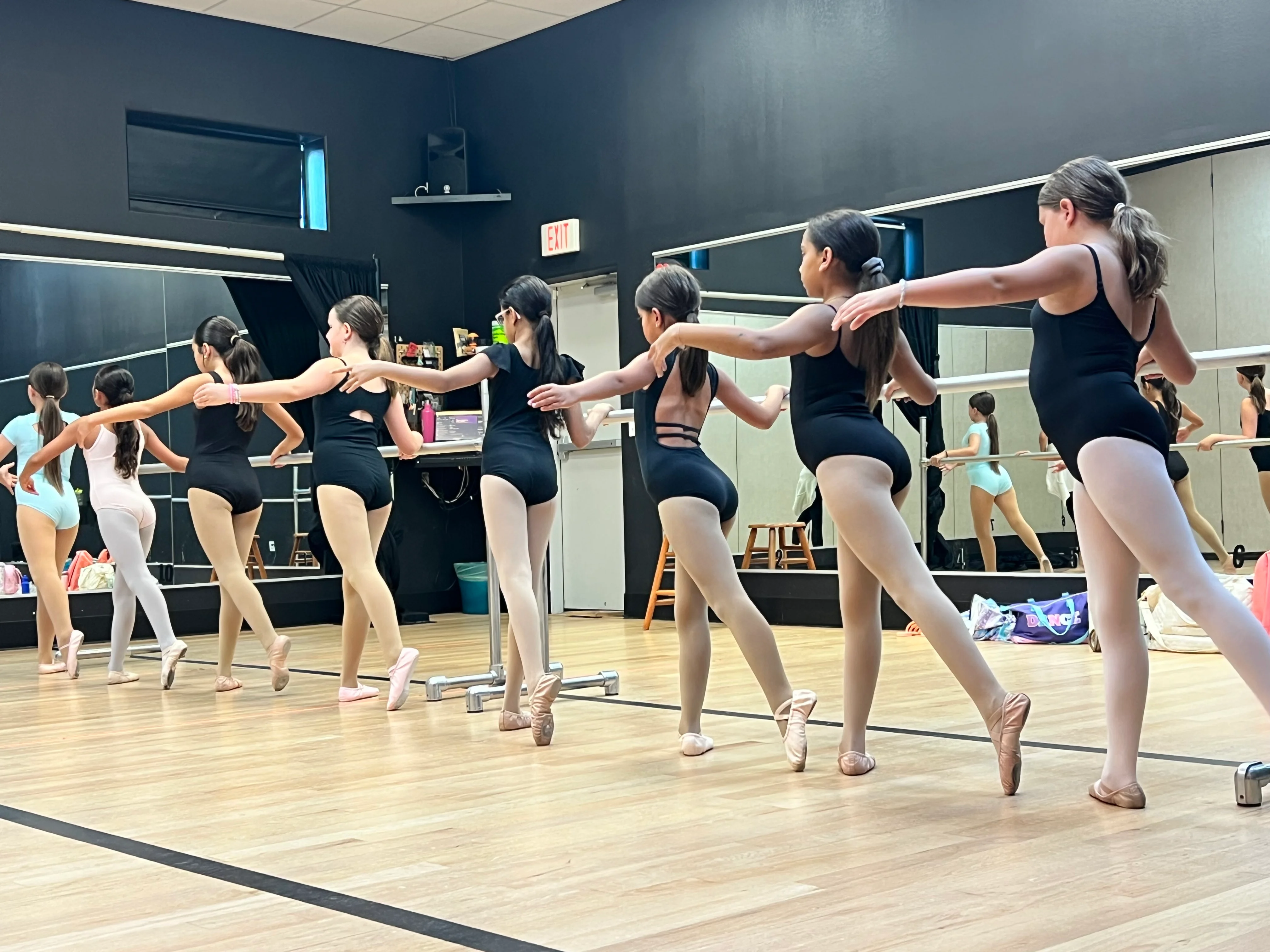
Arms and heads become a standard part of barre. Intricacy of barre exercises increases throughout the year. A STRONG level 2 student will master stylization of basic ballet terminology and be ready to be challenged with more advanced work.
What your dancer works toward
Barre
- Strong foot placement in all 5 positionsNeeded to move up All 5 positions with correct, strong placement, so the feet are clearly differentiated between positions
- Arms and head during barre exercises Incorporates port de bras and head while executing barre work, coordinating upper and lower body simultaneously
Center Work
- Holds turnout in center exercisesNeeded to move up Maintains turnout while executing center work away from the barre
- Clean pirouette prepNeeded to move up Pirouette preparation from 4th or 5th with correct weight distribution, arm placement, and relevé
Across the Floor
- Strong toe/ball/heel in traveling Proper articulation through the foot (toe, ball, heel) when traveling
Learning Skills
- R & L sides without verbal cueing Executes both sides with increasing confidence without teacher direction
After this level
Next: Level 3/A / Beg-Int
A clean single turn from fifth position is what Level 3 works toward all year. Combinations get longer, three or four steps with the arms and head carried through. Dancers learn the jumps by name, and they start hearing the phrase in the music and shaping barre work to it.
What to wear
Tan tights, any black leotard, hair pulled up in bun or braid.
Ballet Level 3/A / Beg-Int
Ages 8 to 18 · 45 minute class · Usually 2 years at this level
A STRONG level 3 student will master heads and arms with all barre exercises. Their feet muscle memory will work through the floor for jumps and all footwork. They will have a lifted center and strong port de bras arms. They will be eager for more advanced combinations of level 4 classwork when they are ready to move on.
What your dancer works toward
Alignment
- Strong posture and alignmentNeeded to move up Maintains long neck, engaged core, reduced curve in lower back. The placement holds steady from the first count to the last
Center Work
- Clean pirouette from 5thNeeded to move up Executes a clean single pirouette from 5th position with spot, passé, and controlled landing
- Working toward pirouette from 4th Attempting pirouette from 4th with correct preparation, even if the full rotation isn't consistent
- Knowledge of sauté types Demonstrates changement, échappé, royale, soubresaut, entrechat quatre, and can identify and execute each on request
Across the Floor
- Executes 3–4 step combos with arms/head Strings 3 or 4 steps together with coordinated arms and head. Verbal cueing is still acceptable
- Tombé pas de bourrée pirouette sequence Executes the standard TPDB en dehors pirouette combination with correct transitions
Musicality
- Phrasing awareness in barre work Begins and ends barre exercises with the musical phrase, neither early nor late
After this level
Next: Level 4/B / Intermediate
Level 4 is where the leftover technique problems get sorted out. Hips stay square and shoulders stay level through fondu développé. Dancers reverse a combination on their own, without being walked through it first. Adagio gets more musical, and extension and turnout become something they can really use.
What to wear
Tan tights, any black leotard, hair pulled up in bun or braid.
Ballet Level 4/B / Intermediate
Ages 11 to 18 · 45 minute class · Usually 2 years at this level
Level 4 students are ready for advanced combos, barrework, and expectations. Level 4 will still be working out technique issues in their bodies, sometimes struggling to still put all the pieces together. Level 4 students will work to strengthen performance, flexibility and progression. Use of head, epaulement, arms combined with footwork is important.
What your dancer works toward
Barre
- Proper placement for fondu développé / RDJ en l'airNeeded to move up Correct hip and shoulder placement (hips square, shoulders level) during fondu développé or rond de jambe en l'air
Learning Skills
- R & L sides on their ownNeeded to move up Repeats both right and left sides WITHOUT verbal cueing, applying the reversal independently
Center Work
- En dehors vs. en dedans pirouette knowledgeNeeded to move up Demonstrates and executes the difference between en dehors and en dedans pirouettes on request
- Petite allegro R to L without cueing Repeats petite allegro combinations from right to left side without teacher direction
Across the Floor
- Confident arms/legs/head across the floor Uses arms, legs, and head simultaneously with confidence. No "dead arms" and no dropped focus
- Clean TPDB en dehors pirouetteNeeded to move up Tombé pas de bourrée into clean en dehors pirouette from 4th position with consistent spot and controlled landing
Musicality
- Musical sensitivity in adagio Sustains movement through adagio phrases with breath and control, so the movement travels through each position on the way to the next
Physical Readiness
- Functional extension and turnout Demonstrates working turnout and extension at or above 90° in développé, holding the leg there with active flexibility rather than passive
After this level
Next: Level 5/C
Barre combinations run longer, with the head and arms carried the whole way through. Turns have to come out clean every time. Small jumps pick up beats, and dancers work toward full splits on both sides and center.
What to wear
Tan tights, any black leotard, hair pulled up in bun or braid.
Ballet Level 5/C
Ages 12 to 18 · 45 minute class · Usually 2 years at this level
A level 5 student is ready for advanced combos, barrework, and expectations. Add Battu, Reverse & En Releve. Dancers in this level have developed a certain polish to their technique. Dancers at this level would know how to push themselves during class.
What your dancer works toward
Barre
- Longer barre combos with head & arms Extended barre combinations (8+ counts of 8) incorporating head and arms, executed clean, polished, and coordinated
Center Work
- Clean, consistent pirouettesNeeded to move up Pirouettes from both 4th and 5th are reliable: clean singles every time, doubles with increasing consistency
- Petite allegro with batterie/reversalNeeded to move up 2–4 counts of 8 petite allegro with added batterie (beats) and/or reversal of the combination
- Clean execution of all sautés All sauté types executed cleanly with pointed feet in the air, soft landings, and musical timing
Across the Floor
- Grand allegro, longer combos Grand allegro combinations of increasing length and complexity with height and extension
Physical Readiness
- Full splits (R, L, and center) Demonstrates full splits on right, left, and center. This is the flexibility foundation required for advanced grand allegro and développé work at Level D
Performance Quality
- Artistry in movement quality Movement has polish and expression, with dynamic quality, breath, and épaulement appropriate to the phrase
After this level
Next: Level D
Level D is the top of our ballet ladder. All eight body positions, forward and reversed. Dancers work toward consistent triple turns and fouettés in the center, and grand jeté en tournant comes in. They also help bring the younger dancers along.
What to wear
Tan tights, any black leotard, hair pulled up in bun or braid.
Ballet Level D
Ages 15 to 18 · 60 minute class · Usually 2 years at this level
Students will have mastery of technique but always working to strengthen performance, flexibility and progression. D students should always be given the entire aspect of their coursework, head, body positions, footwork, arm placement & PERFORMANCE. Add Battu, Reversal of Combo & En Releve
What your dancer works toward
Center Work
- Mastery of 8 body positions (Cecchetti) with reversalNeeded to move up Demonstrates all 8 body positions of the body (croisé devant, à la quatrième devant, effacé, écarté, etc.) and reverses them on request, with correct alignment, épaulement, and port de bras
- Petite allegro with batterie, reversibleNeeded to move up Petite allegro combinations with batterie reversed in any direction, showing full command of the vocabulary including entrechat, royale, and brisé
Turns
- Triple pirouette (working toward consistent)Needed to move up Achieves triple pirouette with correct mechanics. Doubles are automatic and clean from both 4th and 5th on both sides
- Fouetté turns (at barre and center)Needed to move up Executes fouetté turns in center, away from the barre, with stable supporting leg, consistent spot, and controlled whip
Across the Floor
- Grand jeté en tournant and advanced grand allegro Executes grand jeté en tournant, chassé tour jeté, and complex grand allegro combinations with height, extension, and musicality
Performance Quality
- Polished execution with épaulement and artistry Every movement from barre through révérence shows integrated head, épaulement, musicality, and breath. Artistry is inseparable from technique
Studio Engagement
- Leadership and mentorship Leads the class through consistent attendance, full-out effort, and positive influence, modeling professionalism and supporting younger dancers
What to wear
Tan tights, any black leotard, hair pulled up in bun or braid.
Tap
Create music with your feet! Tap dance builds rhythm, coordination, and musicality while dancers learn to produce intricate sounds and patterns.
Tap Level 1
Ages 7 to 10 · 30 minute class · Usually 1 year at this level
Level 1 tappers learn the names of the sounds they make, from steps and brushes to the difference between a stamp and a stomp. Class runs through marches, toe heels, shuffles, ball changes and cramp rolls, mostly to half and quarter notes. By the end of the level a strong dancer finds the one of the beat on their own and can shuffle in any direction, walk step heels sideways, do front and back Irish, and get through basic paradiddles and 4 point riffs. Most move up to Level 2 unless the teacher says otherwise.
What your dancer works toward
Rhythm & Musicality
- Find the beat independentlyNeeded to move up Identifies and moves on the downbeat ("the one") without teacher cueing
- Quarter note paradiddles Basic paradiddle pattern at quarter-note tempo with each sound distinct
Traveling
- Step heel walks to the beat Step heel walks sideways (open and close) ON the beat
- Basic around-the-world step heel Single step heel pattern in the around-the-world circle
Across the Floor
- Front irish / back irish Shuffle hop step traveling forward and backward with clear shuffle sound
Technique
- Shuffle steps in all directions Clean shuffles forward, backward, and sideways, with two distinct sounds per shuffle
- 4-point riffNeeded to move up Clean 4-point riff with 4 distinct, audible sounds
After this level
Next: Level 2
Heel drops and toe drops come in, and the rhythm phrases get longer to hold them. Dancers learn to echo back a rhythm the teacher taps out. Running flaps start across the floor, and the five point riff joins the four.
What to wear
Black tap shoes (transition to oxford tap shoes at higher levels).
Tap Level 2
Ages 7 to 10 · 30 minute class · Usually 2 years at this level
Level 2 keeps the Level 1 sounds and adds heel drops, toe drops, flaps and crawls, with longer rhythm phrases to match. Running flaps come in across the floor, and center work gets into steps like the Maxi Ford. A strong Level 2 tapper can echo back quarter and eighth note rhythms and turn step heels with a spot. Paradiddles in eighth notes should have all four sounds, and 5 point riffs join the 4 point ones.
What your dancer works toward
Rhythm & Musicality
- Call and echo rhythms (8th notes) Echoes rhythmic patterns using quarter and eighth notes, reproducing them accurately within 1 or 2 attempts
- Paradiddle eighth notes (all 4 sounds) Paradiddles at eighth-note tempo with all 4 sounds clearly articulated
Turns
- Step heel turns with spotNeeded to move up Step heel turns traveling with a consistent spot: the eyes find the spot on every rotation
Traveling
- Around-the-world double heel with weight change Double heel pattern with controlled weight change to transition sides
Technique
- 5-point riffNeeded to move up Clean 5-point riff with all sounds distinct
Across the Floor
- Running flaps (beginner) Beginning running flaps, traveling forward with alternating flaps and an even rhythm
Sound Quality
- Sound clarity at tempo Maintains distinct, audible sounds when executing steps at class working tempo, so the sounds don't blur together
After this level
Next: Level 3/A / Beg-Int
The steps are familiar by now, so Level 3 speeds them up and puts them into harder rhythms. Dancers learn to hear straight time against swing time. The waltz clog and a basic time step arrive, and pullbacks get a first try.
What to wear
Black tap shoes (transition to oxford tap shoes at higher levels).
Tap Level 3/A / Beg-Int
Ages 8 to 18 · 30 minute class · Usually 2 years at this level
This level challenges the basics: familiar steps get faster and go into harder rhythm phrases, and dancers learn to hear straight time against swing time. Weight shifting gets a lot of attention through pineapples, flap heel sequences, the Buffalo and In the Mood. A strong dancer finishing the level has solid running flaps, flaps with one or two heel drops, a waltz clog and a basic time step. They can do single and double paradiddles and have had a first go at pullbacks.
What your dancer works toward
Across the Floor
- Solid running flapsNeeded to move up Clean, consistent running flaps with even rhythm and clear sounds
Technique
- Flap heel drops with weight shifting Flap with one and two heel drops, demonstrating controlled weight shifts between feet
- Waltz clog Step shuffle ball change pattern executed cleanly in 3/4 time
- Basic time stepNeeded to move up Executes the standard time step pattern with correct rhythm and weight placement
- Pullbacks (introduction) Attempting pullbacks, with some lift off the floor on both feet; mastery is not expected
Rhythm & Musicality
- Double paradiddle Single AND double paradiddle patterns with all sounds clearly articulated
- Responds to tempo changes Adjusts step speed when the music tempo changes instead of continuing at the same speed regardless of the music
After this level
Next: Level 4/B / Intermediate
Rhythms move into eighth notes, and teachers push musicality as hard as the steps. Leap shuffles have to be clean, with no horse gallop in them. The traveling time step and the eight point riff show up, soft shoe too, and wings get introduced.
What to wear
Black tap shoes (transition to oxford tap shoes at higher levels).
Tap Level 4/B / Intermediate
Ages 11 to 18 · 30 minute class · Usually 2 years at this level
Rhythms move into eighth notes here, and teachers push musicality along with the basics. Dancers pick up bombershays, drawbacks, paddle turns, back essence and thirds, and center work adds the Shirley Temple, soft shoe, wings and syncopated pullbacks. By the end of the level a strong tapper does leap shuffles without a horse gallop and turns using flap heels or cramp rolls. They should have a traveling time step and an 8 point riff, with pullbacks and wings getting fast and clear.
What your dancer works toward
Turns
- Flap heel turns / cramp roll turnsNeeded to move up Turns with rhythmic footwork, holding the spot and keeping clean sounds through every rotation
Across the Floor
- Leap shuffles (no horse gallop) Airborne shuffle traveling forward with clear separation from the floor and two distinct shuffle sounds in the air
Technique
- Traveling time stepNeeded to move up Time step pattern executed while traveling across the floor. The rhythm stays consistent while moving
- Triple time step Double-double and triple time step variations with correct accents
- 8-point riffNeeded to move up Clean 8-point riff with all 8 sounds distinct at moderate tempo
- Soft shoe / back essence Spank pas de bourrée pattern that demonstrates the rhythmic swing of the back essence
- Pullback masteryNeeded to move up Consistent pullbacks with clean landing: both feet achieve full lift and the landing is controlled
- Wings (introduction) Attempting wings, with an audible wing sound; consistency is still developing
Sound Quality
- Clarity at faster tempos Executes combinations at increased speed without losing sound clarity or distinct articulation
After this level
Next: Level 5/C
Level 5 goes down to sixteenth notes. Anything that travels has to come back the other way, so a combination going forward gets reversed. Dancers add paddle and rolls and syncopated wings, and they start improvising with real control over how loud or soft each sound lands.
What to wear
Black tap shoes (transition to oxford tap shoes at higher levels).
Tap Level 5/C
Ages 12 to 18 · 45 minute class · Usually 2 years at this level
Rhythms here go down to sixteenth notes, and teachers push speed and weight changes along with straight and swing time. Anything that travels gets reversed, so a combination going forward also has to come back. New steps include paddle and rolls, pressed cramp rolls, reverse turns, the Hines riff and a 16 point riff, next to syncopated pullbacks and wings. In improv, dancers work on volume, how loud or soft each sound comes out.
What your dancer works toward
Technique
- Syncopated wingsNeeded to move up Consistent wings executed with syncopated rhythmic patterns, placing wing sounds on off-beats with control
- Double back essence Double spank pattern in the back essence, with increased speed and complexity while maintaining the swing
Turns
- Reverse rhythm turns Paddle turns and rhythm turns with reversed rhythmic phrasing
Rhythm & Musicality
- Advanced paradiddle manipulationsNeeded to move up Paradiddle variations with clean sounds: para 5, para 6, para 7, reverse paradiddle
Musicality & Performance
- Improvisation (structured, 8 counts) Improvises rhythmic patterns using 16th-note subdivisions within a structured 8-count format
Sound Quality
- Tonal variation (light and shade) Varies volume and tonal quality intentionally, distinguishing between accented and ghosted notes
Combinations
- Picks up combinations quickly Learns and retains new tap combinations with minimal repetition and executes them correctly after 3 or 4 run-throughs
What to wear
Black tap shoes (transition to oxford tap shoes at higher levels).
Jazz
High-energy choreography with sharp technique and a lot of personality. One of our most popular styles.
Jazz Level 1
Ages 7 to 9 · 30 minute class · Usually 1 year at this level
Level 1 (ages 7-9) is designed for beginning jazz dancers, dancers aging out of our LITTLES program, or students with limited jazz training. The primary focus is introducing fundamental jazz technique, terminology, musicality, and classroom expectations while building confidence and body awareness.
What your dancer works toward
Foundations
- Jazz walks with technique Pointed feet and proper placement while traveling, with the toes leading and the weight controlled
- Basic footwork vocabulary Executes 3-step turn, pivots, jazz square, ball changes with correct weight placement
- Basic isolations Head, shoulders, and hips can move independently, isolating the targeted body part
Turns
- Pirouette prep with spot Quarter/half turn prep showing correct feet position, passé connection, supporting leg engaged, and use of spot
Combinations
- Strings 2–3 steps with arms Links several learned steps in a short combination while coordinating arm movements
Musicality
- Moves on the beat Executes learned steps on the correct counts. The timing holds steady without rushing or lagging
After this level
Next: Level 2
A single turn on both sides, every time, is the standard in Level 2. Chaîné turns stay on a straight line, and step leaps get the arms. Grand jeté comes in, and dancers take their first swings at a double.
What to wear
Any color leotard, shorts or leggings (tights optional), tan jazz shoes.
Jazz Level 2
Ages 7 to 10 · 30 minute class · Usually 2 years at this level
Level 2 (ages 8-10) is designed for dancers who have a foundational understanding of beginning jazz technique and vocabulary. Building upon the Level 1 curriculum, the emphasis shifts from learning the steps to refining technique, developing consistency, and improving movement quality. Dancers are expected to execute foundational skills with greater control, confidence, and attention to detail.
What your dancer works toward
Turns
- Single pirouette R & LNeeded to move up Clean single pirouette on both sides, every time
- Chaîné turns with techniqueNeeded to move up Spotting, straight knees, staying in relevé throughout, with no falling off center
- Double pirouette (attempted) Working toward double, attempting it with correct preparation and mechanics
Leaps
- Chassé step leap with arms R & LNeeded to move up Chassé into step leap with correct arms on both sides. The leap gets height and the front leg extends
- Grand jeté Grand jeté with height and split: legs extend fully and the landing is controlled
Foundations
- Solid footwork (consistent technique) Pivots, ball changes, cross ball change, and pas de bourrée, all with consistent pointed feet and clean execution
After this level
Next: Level 3/A / Beg-Int
The double turn becomes real work in Level 3, with the mechanics that make it repeatable. Dancers change spot direction quickly inside a turn and travel triplets across the floor. They also start catching the accents in the music.
What to wear
Any color leotard, shorts or leggings (tights optional), tan jazz shoes.
Jazz Level 3/A / Beg-Int
Ages 8 to 18 · 45 minute class · Usually 2 years at this level
Level 3 (ages 11-15) is designed for dancers with a strong understanding of foundational jazz technique who are ready to expand their technical vocabulary and movement complexity. Dancers should demonstrate consistency in foundational skills while applying them to more advanced progressions, combinations, and directional changes.
What your dancer works toward
Turns
- Double pirouette with techniqueNeeded to move up Attempting double with correct preparation, spot, and passé. The mechanics are correct even if the turn isn't consistent yet
- Quick spot changesNeeded to move up Changes spot direction rapidly in combination turns (e.g., chaîné ball change pirouette) without losing balance
- 6-step pirouette Executes the 6-step pirouette sequence with correct weight transfers
Combinations
- Strings skills into combos easily Links different steps in longer combinations or across-the-floor progressions without hesitation
Physical Readiness
- Flexibility (working toward splits) Demonstrates active flexibility, reaching full splits or coming within 4 to 6 inches
Traveling
- Triplets across the floor Clean triplet pattern traveling with down-up-up rhythm and arm coordination
Musicality
- Responds to musical accents Hits accents and dynamic changes in the music, so the movements get bigger or sharper when the music does
After this level
Next: Level 4/B / Intermediate
A solid double turn on both sides is the standard here. Leaps go right and left with real height, and footwork has to stay clean as the tempo climbs. Dancers pick up choreography fast and perform with visible light and shade.
What to wear
Any color leotard, shorts or leggings (tights optional), tan jazz shoes.
Jazz Level 4/B / Intermediate
Ages 12 to 18 · 45 minute class · Usually 2 years at this level
Level 4 (ages 12-15) is designed for experienced jazz dancers who demonstrate a strong technical foundation and are ready to integrate more advanced skills, complex progressions, and stylistic choices. Dancers should be able to maintain clean technique while navigating changes in direction, level, weight, and movement quality with increasing independence.
What your dancer works toward
Turns
- SOLID double pirouette R & LNeeded to move up Consistent, controlled double pirouette on both sides, completing two full rotations with clean spot and controlled landing. This one is required before moving to Level 5
Leaps
- Right & left leaps with height and extensionNeeded to move up All leap vocabulary (step leap, grand jeté, x-leap) executed on both sides with full leg extension and visible height
Performance Quality
- Performs with musicality and dynamics Executes combinations with visible dynamic contrast (sharp vs. smooth, big vs. contained) and responds to musical phrasing
Foundations
- Clean footwork at faster tempos All footwork vocabulary executed cleanly when speed increases, with pointed feet and correct weight placement maintained at tempo
Physical Readiness
- Strong flexibility Working toward or at full splits (right, left, and center); measurable progress from prior level
Combinations
- Learns choreography quickly Picks up and retains new 8-count combinations with minimal repetition, executing them correctly after 3 or 4 run-throughs
After this level
Next: Level 5/C
Level 5 is our most advanced jazz level. Dancers work turns individually, fouettés and à la seconde and pencil turns, and push toward a triple. Full splits on both sides and center. They bring their own reading to the choreography.
What to wear
Any color leotard, shorts or leggings (tights optional), tan jazz shoes.
Jazz Level 5/C
Ages 14 to 18 · 45 minute class · Usually 2 years at this level
Level 5 (ages 14-18) is designed for advanced jazz dancers who demonstrate a strong technical foundation, consistent movement quality, and the ability to apply corrections independently. Dancers are expected to integrate advanced skills into increasingly complex movement while demonstrating control, versatility, musicality, and individual artistry.
What your dancer works toward
Turns
- Individual advanced turnsNeeded to move up Demonstrates fouetté, à la seconde, and pencil turns individually with correct mechanics. Each turn type is executed with control and a clean finish
- Triple pirouette (working toward) Attempting triple pirouette with correct mechanics, achieving 2.5+ rotations with proper spot and controlled finish
Physical Readiness
- Full splits (R, L, and center)Needed to move up Demonstrates full splits on right, left, and center, which is a concrete physical benchmark for this level
Performance Quality
- Nuanced musical interpretation Demonstrates sensitivity to musical accents, breath, suspension, and texture, so both the timing and the quality of the movement change with the music
- Commands the space with confidence Performs with full-body engagement, focus, projection, and personal expression, so the audience can see the dancer's intention
Combinations
- Learns and adapts choreography rapidly Learns complex choreography quickly and layers personal stylistic interpretation
What to wear
Any color leotard, shorts or leggings (tights optional), tan jazz shoes.
Hip Hop
Street-style dance that emphasizes rhythm, musicality, and personal style. Hip hop builds confidence and lets dancers express their individuality.
Hip-Hop Jr.
Ages 5 to 6 · 45 minute class · Usually 2 years at this level
Hip-Hop Jr. dancers learn the same first steps as Hip Hop 1, like step touches, grapevines, PBJ walks and hip hop walks. They work on keeping time with the music and changing their energy from big to small. Finding their own place in the room is part of it too. Each combo builds over two weeks, so dancers practice remembering steps and adding new ones on.
After this level
Next: Level 1
Hip Hop 1 gives the basics names kids remember, like criss cross applesauce and PBJ walks. The first tricks come in, turtle spins and ninja kicks. Every class ends with a combo and some freestyle, so dancers start finding their own personality right away.
What to wear
Comfortable clothing, hip-hop sneakers (studio-only use required).
Hip Hop Level 1
Ages 7 to 9 · 45 minute class · Usually 2 years at this level
Hip Hop 1 teaches the basic moves under names kids remember, like criss cross applesauce, PBJ walks, funky walks and top rock steps. There are tricks too, including turtle spins, ninja kicks, the corkscrew and coffee grinders. Every class ends in a combo and improv, and freestyle starts right away so each dancer begins to find their own hip hop personality. A strong dancer finishing the level adds arms and levels to pivot turns and can hit poses in the middle of hip hop walks.
What your dancer works toward
Foundations
- Pivot turnsNeeded to move up Clean pivot turns with balance. The turn finishes without stumbling or losing direction
- Criss cross apple sauce Executes the criss cross pattern with rhythm, crossing and uncrossing the feet on the correct counts
- Grapevine Clean grapevine traveling sideways on the beat: step-behind-step-touch with rhythmic consistency
Combinations
- Links skills with arms/levels Can take basic skills and add arms and/or level changes as directed
Groove & Musicality
- Can start to clap & find beat of music Maintains a basic bounce/pulse with the beat so the body responds to the music's rhythm
After this level
Next: Level 2
Level 2 goes back over the same moves and asks a lot more of them, more energy and more power. Dancers start putting their own style into it, with arms and level changes layered on. They run across-the-floor combos on their own and hold the groove through a whole piece of choreography.
What to wear
Comfortable clothing, hip-hop sneakers (studio-only use required).
Hip Hop Level 2
Ages 8 to 11 · 45 minute class · Usually 2 years at this level
Level 2 goes back over the Hip Hop 1 moves and asks for a lot more style, adding arms and levels and new ways to finish steps like grapevines. The big step is linking skills together and remembering choreography. New moves include the tick tock stop and kick cross ball change, and the trick list keeps growing, all the way up to the worm. Dancers also make up dances in groups.
What your dancer works toward
Foundations
- All Level 1 skills with energy and powerNeeded to move up Pivot turns, criss cross, grapevine, kick cross touch, rock steps, three step turns, and tic toc stop, all executed with energy and strength and danced full out
Combinations
- Links skills with personal stylizationNeeded to move up Beginning to put personal style into skills and combos, with intentional variation of their own rather than a copy of the teacher
- Across-the-floor combos independentlyNeeded to move up Performs across-the-floor progressions and combos with little to no assistance from teacher
Groove & Musicality
- Groove maintained through combinations Keeps the underlying bounce/groove going while executing choreography. The groove stays alive even when the focus goes to the steps
After this level
Next: Level 3
Class keeps moving in Level 3 until dancers come out sweating. Head, chest and hip isolations have to be clean on their own. Dancers freestyle for eight or sixteen counts and perform combos in groups.
What to wear
Comfortable clothing, hip-hop sneakers (studio-only use required).
Hip Hop Level 3
Ages 10 to 13 · 45 minute class · Usually 2 years at this level
Hip Hop 3 opens the season with a review of the Level 2 skills, and from there classes keep moving until dancers are sweating. Warm-ups are high energy and built around grooves, and every class has strengthening and work across the floor. Once a combo is learned, dancers break into groups to perform it, and there's a lot of freestyle.
What your dancer works toward
Foundations
- All prior skills with confidence and powerNeeded to move up Every Level 1 and 2 skill executed with full energy, power, and confidence, dancing the steps with full commitment
Musicality & Performance
- Freestyle / improvisation (basic)Needed to move up Freestyles for 8 to 16 counts with personal style, using a variety of movements (not one repeated step) and responding to the music
Body Control
- Clean single-joint isolations (head, chest, hips) Isolates head, chest, and hips independently: the targeted body part moves while the rest stays stable
Combinations
- Combo retention and execution Learns and retains longer combinations (16+ counts); executes in groups independently
Physical Readiness
- Physical intensity and stamina Maintains high energy throughout class, with no visible fade in effort during the second half
Performance Quality
- Stage presence in group performance Brings energy, focus, and commitment when performing in groups, holding character even when not in the front row
Groove & Musicality
- Awareness of musical structure Demonstrates awareness of phrases, hits, and breaks in the music during both freestyle and choreography. Beyond dancing on the beat, begins to dance with the music
After this level
Next: Level 4
Body waves come in, and isolations start stacking across more than one joint. Freestyles run two eights or longer. Dancers meet the styles hip hop is built on, popping and locking among them, and they pick up complicated choreography fast.
What to wear
Comfortable clothing, hip-hop sneakers (studio-only use required).
Hip Hop Level 4
Ages 12 to 18 · 45 minute class · Usually 2 years at this level
Hip Hop 4 is a high energy class, and dancers should come out sweating every time. Warm-ups are built on grooves. Every class includes strengthening, and the season starts with work across the floor. After a combo is learned, dancers perform it in groups, with lots of improv and freestyle along the way.
What your dancer works toward
Body Control
- Body waves and multi-joint isolationsNeeded to move up Executes clean body waves (chest-to-hips or full body) and multi-joint isolations with control. This is a qualitative jump from Level 3's single-joint work
Musicality & Performance
- Extended freestyle with musicalityNeeded to move up Freestyles for 2+ eights showing varied movement, level changes, and response to musical shifts (tempo changes, drops, breaks)
Foundations
- Foundation style awareness Can identify and demonstrate basics from at least 2 foundation styles beyond general hip-hop (e.g., popping, locking, house, breaking), and understands that they exist as distinct vocabularies
Combinations
- Learns complex choreography quickly with style Picks up complex choreography rapidly and immediately adds personal interpretation
Performance Quality
- Dynamic contrast in performance Shows intentional variation between hard/soft, fast/slow, big/small, so the performance moves between energy levels
Groove & Musicality
- Musicality beyond the downbeat Catches syncopation, hits, and accents in the music, so the movement reflects the musical structure beyond the main beat
After this level
Next: Level 5
Level 5 asks for freestyle that holds up over thirty-two counts, and real range across three or more styles. Dancers make up their own phrases and teach them. Dancers at this level set the tone for the younger classes.
What to wear
Comfortable clothing, hip-hop sneakers (studio-only use required).
Hip Hop Level 5
Ages 14 to 18 · 60 minute class · Usually 2 years at this level
Level 5 keeps the pace of Hip Hop 4. Dancers warm up with grooves at high energy and do strengthening in every class, and they should be sweating by the end. Across the floor work leads off the season. Combos finish with dancers performing in groups, and freestyle comes up again and again.
What your dancer works toward
Musicality & Performance
- Confident, extended freestyleNeeded to move up Freestyles for 32+ counts with confidence, variety, musicality, level changes, and clear personal identity. Commands the cipher/circle
Foundations
- Versatility across 3+ hip-hop sub-stylesNeeded to move up Demonstrates competence in at least 3 foundation styles (popping, locking, house, breaking, waacking, krumping). Can switch between styles on request and show authentic quality in each, which goes beyond basic awareness
Body Control
- Advanced isolations and body controlNeeded to move up Executes complex multi-joint isolations, tutting sequences, and controlled body waves at performance speed, with precision and control that would hold up in an audition setting
Combinations
- Choreographic voice Can create, structure, and teach original movement phrases. This shows a personal choreographic perspective on top of performance ability
Performance Quality
- Performance artistry and stage presence Commands the space with dynamic contrast, musicality, individuality, and full commitment. This is the dancer the audience watches
Studio Engagement
- Leadership and mentorship Supports younger dancers through example and encouragement; could assist-teach if needed; represents the program inside and outside the studio
What to wear
Comfortable clothing, hip-hop sneakers (studio-only use required).
Musical Theater
Dance meets acting and singing! Musical theater classes develop triple-threat performers through choreography inspired by Broadway shows and classic musicals.
Musical Theater Level 1
Ages 7 to 9 · 60 minute class · Usually 2 years at this level
Students will learn basic movement, dance, and singing vocabulary. They will work on developing spatial awareness and coordination. Instruction will focus on clarifying movements, rhythmic accuracy, and developing choreographic learning abilities. Through guided exercises, across the floor, short combinations, the students will develop their technical skills. Through improv games and activities students will develop their ability to think quickly, adapt and commit to character choices, and perform in front of an audience. This level will prepare the students for continued training in musical theatre dance and performance. It will introduce students to the standard musical theatre audition process, in preparation for musical storytellers as well as community auditions.
After this level
Next: Level 2
Level 2 builds on the movement and singing vocabulary from Level 1. Sharp movement and rhythmic accuracy get real attention, and dancers work on stage presence. Character work starts here, figuring out who someone is and playing a scene with a partner.
What to wear
Activewear and tan jazz shoes.
Musical Theater Level 2
Ages 8 to 12 · 45 minute class · Usually 2 years at this level
Students will build upon the basic movements, dances, and singing vocabulary taught in Level 1. They will continue to work on developing spatial awareness, coordination, and stylistic elements. They will work on developing their stage presence and musicality. Instruction will focus on sharpness of movements and rhythmic accuracy. Students will begin to explore characterization techniques through character and story analysis. Through guided exercises, across the floor, short combinations, the students will continue to develop their technical skills. Through improv games and activities students will develop their ability to think quickly, adapt and commit to character choices when working in a scene with partners and performing in front of an audience. This level will prepare the students for continued training in musical theatre dance and performance. It will continue to prepare students for musical theatre audition processes, in preparation for musical storytellers as well as community auditions.
After this level
Next: Level 3
Level 3 goes further into character. Dancers work on professionalism on stage and off it, and instruction leans on sharpness and rhythm. Most of that happens through short combinations and work across the floor.
What to wear
Activewear and tan jazz shoes.
Musical Theater Level 3
Ages 10 to 14 · 60 minute class · Usually 2 years at this level
Students will review movement, dance, and singing vocabulary. They will continue to work on developing coordination and stylistic elements; as well as, work on developing their stage presence, musicality, and on and off stage professionalism. Instruction will focus on sharpness of movements, rhythmic accuracy, and characterization techniques. Through guided exercises, across the floor, short combinations, the students will continue to develop their technical skills. Through improv games and activities students will develop their ability to think quickly, adapt and commit to character choices when working in a scene with partners and performing in front of an audience. This level will prepare the students for continued training in musical theatre dance and performance. It will continue to prepare students for musical theatre audition processes, in preparation for musical storytellers as well as community auditions.
After this level
Next: Level 4
Level 4 studies style straight from Broadway shows. Technique keeps building underneath that, along with stage presence and the habits of working professionally.
What to wear
Activewear and tan character heels.
Musical Theater Level 4
Ages 12 to 16 · 45 minute class · Usually 2 years at this level
Students will continue to develop technical fundamentals while examining stylistic elements from Broadway productions. They will continue to learn and develop their stage presence, musicality, and on and off stage professionalism. Instruction will focus on sharpness of movements, rhythmic accuracy, characterization techniques. Through structured exercises and combinations, students will explore how style, musicality, and technique inform performance in musical theatre. Instruction will include emphasis on accuracy, consistency. Through improv games and activities students will develop their ability to think quickly, adapt and commit to character choices when working in a scene with partners and performing in front of an audience. It will continue to prepare students for musical theatre audition processes, in preparation for musical storytellers as well as community auditions.
What to wear
Activewear and tan character heels.
Questions from parents
How many students are in each dance class?
We believe in limiting class sizes so your child gets the attention they deserve. Creative movement classes are usually limited to 8 students, and our 5/6 combo classes are limited to 10. Please contact the front desk for more specific questions.
How long is the dance class session?
We operate on a school calendar. Fall classes start after Labor Day and run through the end of May. While we accept registrations throughout the fall and early January, it's best for students to begin the full year with a class to ensure they learn the technique and curriculum designed for their age level.
Can my child make up a class?
During fall classes, dancers may make up a class within the same month. We do not allow makeups in the spring semester due to recital prep. Make-ups must be scheduled in advance by calling the front desk or emailing admin@greateraustindance.com.
My child is advanced for their age. Can they move up to the next level?
All classes are designed for a specific age group. We're happy to evaluate your child if you feel a different level is needed, but we'll ask to observe them in their current level first. Many factors go into level placement besides dance ability: attention span, muscle development, focus, and technique are all considered.
What program is right for my child?
How do students advance between levels?
Can my child try a class before enrolling?
What ages are Littles classes for?
Does my child need prior dance experience for Littles?
What's the difference between Recreational and Intensive?
How long do students typically stay at each Recreational level?
How do students get into the Intensive track?
What's the time commitment for Intensive dancers?
Is the Foundations program only for beginners?
Can Foundations students move to Recreational or Intensive?
What ages is the Foundations program for?
Ready to find a class?
Find open spots and class times on the schedule.